on March 30, 2026
Published on March 16, 2026 Updated on March 16, 2026

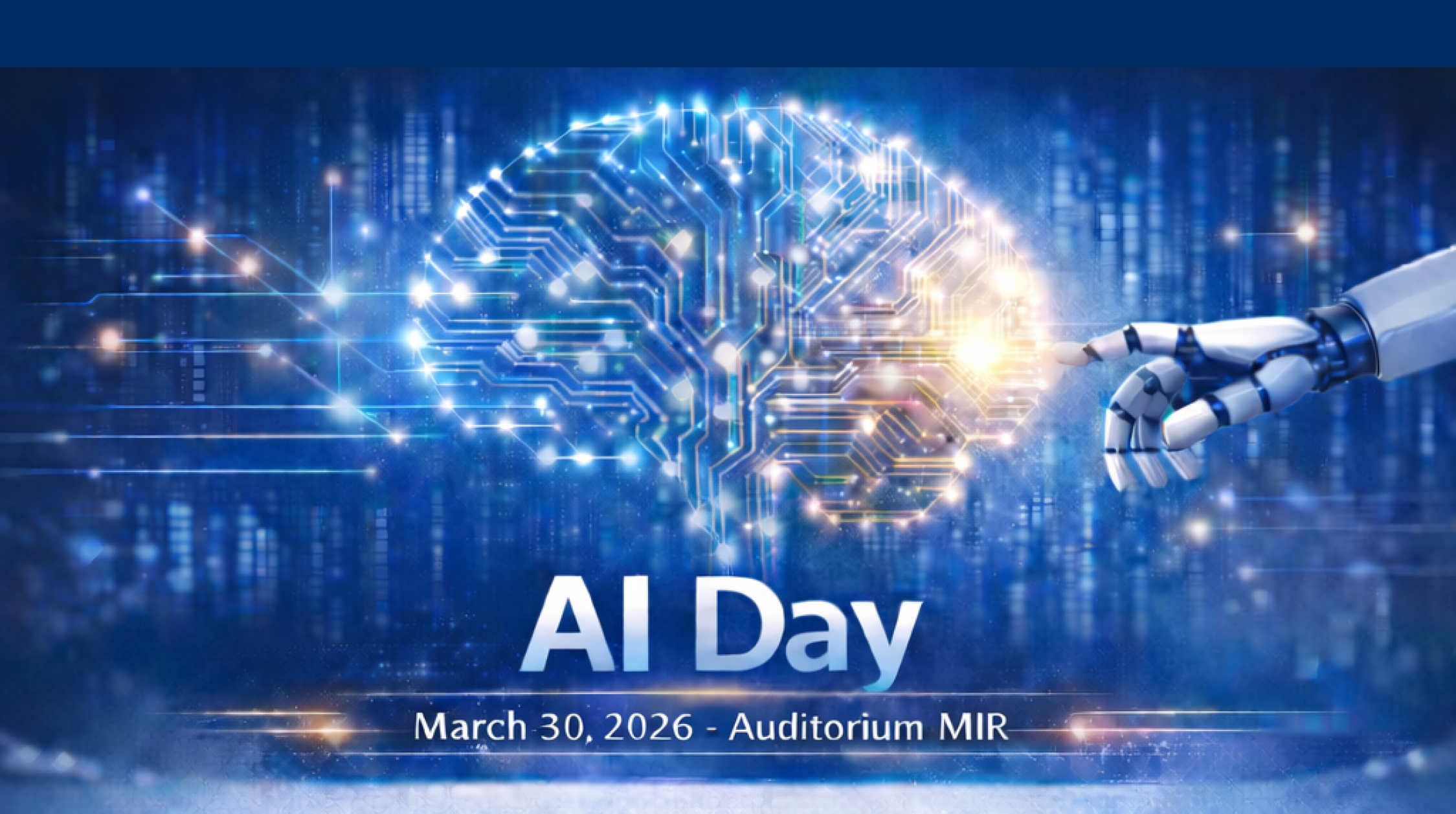
AI Day

Venue: La Maison Internationale de la Recherche, Neuville-sur-Oise
Conférence organised by Demetrio Da Silva Filho, fellow-in-residence at CY Advanced Studies hosted by LPPI laboratory.

Vassilis Christophides, CY ETIS - ENSEA: Accelerating Science with AI
Artificial Intelligence acts as a catalyst for scientific progress by enabling greater efficiency and by pushing the boundaries of scientific knowledge. It is particularly well suited to the processes of scientific discovery and innovation, and is becoming an indispensable tool for research involving the analysis of large-scale scientific datasets and the generation of predictions—for example, in the discovery of new materials or new drugs.
In this talk, we will present the main pillars of the scientific method accelerated by AI:
  • Generative models autonomously propose new hypotheses that expand the discovery space;
  • Robotic laboratories automate experimentation by linking digital models with physical testing;
  • Advanced data analysis, integrated with simulation and experimentation, extracts new knowledge;
  • Machine representations of knowledge allow discoveries to be verified, gaps to be identified, and new research questions to be formulated;
  • Large-scale extraction, integration, and reasoning over scientific knowledge.
Michele Linardi, CY ETIS: From Projects to Competencies: Using AI to Transform Higher Education Pedagogy
Artificial Intelligence (AI) plays an emerging role in reexamining the foundations of Competency-Based Education (CBE) (a largely adopted paradigm in France).
As presented by the work of Jacques Tardif, the two core pillars of such kind of this pedagogical method is motivation and coherence:
  • Motivation relates to the learner’s engagement, perception of usefulness, value of tasks, and sense of feasibility.
  • Coherence ensures that learning activities, resources, and assessment methods are aligned with the competencies to develop.
In this talk, I will share my dual experience as a computer science instructor (adopting CBE) and machine learning researcher, utilizing and designing generative AI for educational purposes. I will also present results and lessons from the IA et Rétroactions Pédagogiques sur Plateforme (IA&RPP) project, in which I collaborate with colleagues from the EMA and LDAR laboratories.

More information
To join coffee-break and lunch